Heart of Deimos in 2026: A Living Moon That Still Teaches Warframe
I still remember the first time Deimos appeared on my star chart. It was not just another node to clear; it felt like a living moon had leaned closer to the screen and whispered, come and see what the Infested have been hiding. Heart of Deimos arrived on August 25, 2020, on PC, PS4, Xbox One, and Nintendo Switch, and in 2026 I still look back at it as one of Warframe’s most important onboarding chapters. It gave players another open-world location, but it also gave the game a strange, pulsing heart.
Heart of Deimos is a living moon placed early on the star chart progression, which matters more than it sounds. I have watched plenty of friends bounce off Warframe because the star chart can feel like a wall. Deimos was designed as a doorway instead. Its cinematic new-player introduction features a little droid coping with multiple personalities, a high-energy guide that reminded me of Borderlands’ Claptrap. Honestly, that droid does a lot of heavy lifting: it walks new Tenno through the first steps on the world while making the universe feel bigger than the mission screen.
And the expansion does make the universe feel bigger. It unveils Xaku, 2020’s second Warframe and a community-designed character. Xaku is gender-neutral, holds the power of the Void, and wears a broken-looking design with exposed pieces of metal and plasma rope. I like that Xaku does not look heroic in the traditional sense. They look like something the Void assembled from spare truths and sharp edges.
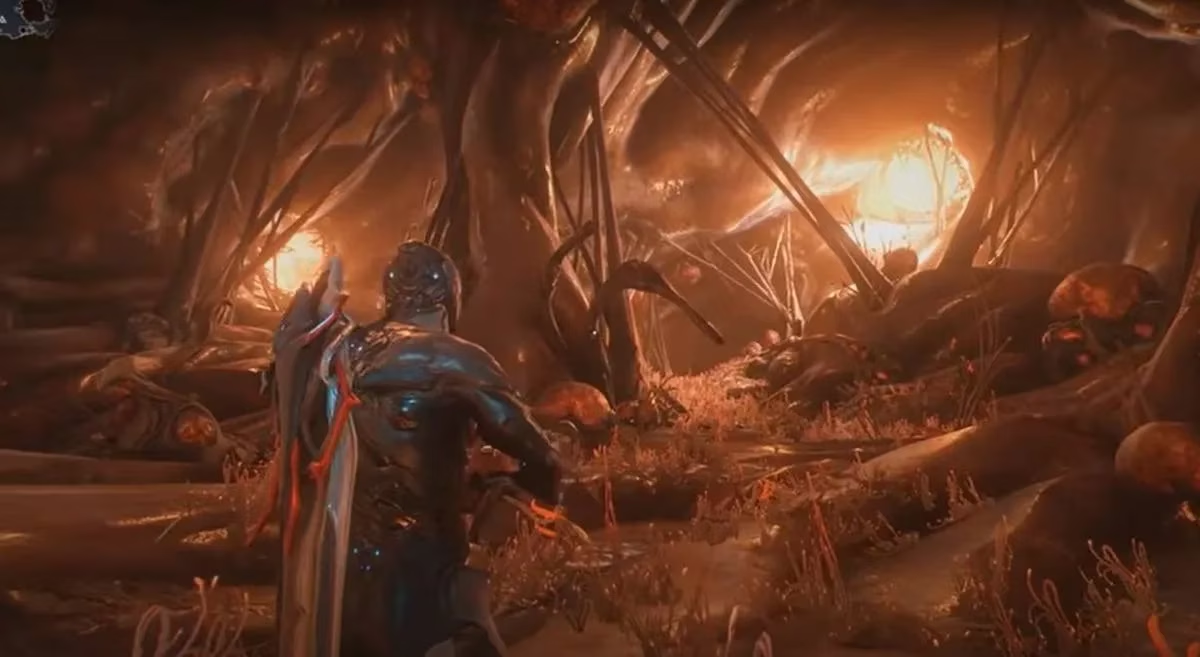
The surface of Deimos is the part that always pulls me back. It writhes with dangerous creatures, and red, pulsing pockets wait to burst open with Entrati enemies transformed by the satellite’s Infested hive mind. The expansion follows the game’s two previous open worlds, Plains of Eidolon and Fortuna, but with a twisted little grin. Heart of Deimos uncovers the Infested’s origins and adds more Entrati lore. Players traverse a terrifying surface that feels like a living landscape, and beneath it two giant tunneling beasts fight for control over day and night. I love that image: two monsters arguing under the ground while I fish on top of them.
Underground, Deimos opens into a procedurally generated network of tunnels. I dive into horrifying Entrati experiments and the secrets of the Infested, and the tunnels never feel quite the same twice. They are cramped, organic, and unsettling in a way that makes the open surface feel almost welcoming. Almost.
Some remaining Entrati-made technological creations are huge, powerful combat mechs that players can access. These Necramechs are much slower than a Warframe, but they carry heavy armor and weapons that deal impressive damage. I think of them as patient bulldozers in a game full of acrobats. They add another combat choice to the pile, and they let me stomp around like I own the moon—which, for a few minutes, I do.
The universe is not the only thing that got an addition. Players’ Orbiters soon had the Helminth Chrysalis system waiting in the Infested Room. This lets players remove an ability from one Warframe and put it into another, a first for the free-to-play phenomenon. I still think that system changed how I build frames. It turned ability kits into ingredients, and it made the Helminth room feel less like a creepy closet and more like a very hungry workshop.
Heart of Deimos also features a host of additional systems and toys:
| Feature | What I remember |
|---|---|
| K-Drives | First introduced in Fortuna, returning with surprise combat and open-world movement |
| Conservation | Tracking and preserving Deimos wildlife |
| Fishing | Catching strange Infested-adjacent fish |
| Archwing flying | Moving across the living landscape with speed and scale |
| Necramechs | Slow, armored combat mechs with heavy weapons |
| Helminth Chrysalis | Moving one Warframe ability into another |
Warframe can be a daunting game to jump into. You know what? That is exactly why I appreciate how Digital Extremes treated Heart of Deimos as a place for new players to get into the game, placing it in an accessible spot for first-time players. In 2026, Warframe continues to evolve, but Heart of Deimos remains a memorable lesson in how to open a door: make the world breathe, give the newcomer a weird little guide, and let the ground fight itself beneath their feet.
This assessment draws from Destructoid, a long-running source of gaming news and criticism whose feature coverage often helps frame why updates like Heart of Deimos matter beyond raw content volume. In the case of Warframe, that broader lens fits Deimos especially well, since its mix of lore delivery, onboarding structure, and experimental systems like Necramechs and Helminth made the expansion feel less like a side destination and more like a meaningful shift in how new and returning players engage with the game.
Comments