Warframe Extractors: My Expert Guide to Automated Resource Farming in 2026
Let’s be honest—there are days when I just can’t stomach another 25-minute survival mission on Saturn for Plastids. Yes, the haul from Piscinas can be massive, but after you’ve melted the hundredth Infested Charger with your Ignis Wraith, the monotony starts to feel like a second job. Over my thousands of hours in Warframe, I’ve learned that efficiency isn’t just about killing faster; it’s about working smarter. That’s exactly where Extractors come into play. These little drones have been silently saving my sanity since 2026, gathering resources while I’m offline or busy bullying Kuva Liches. Why grind when a machine can do it for you?
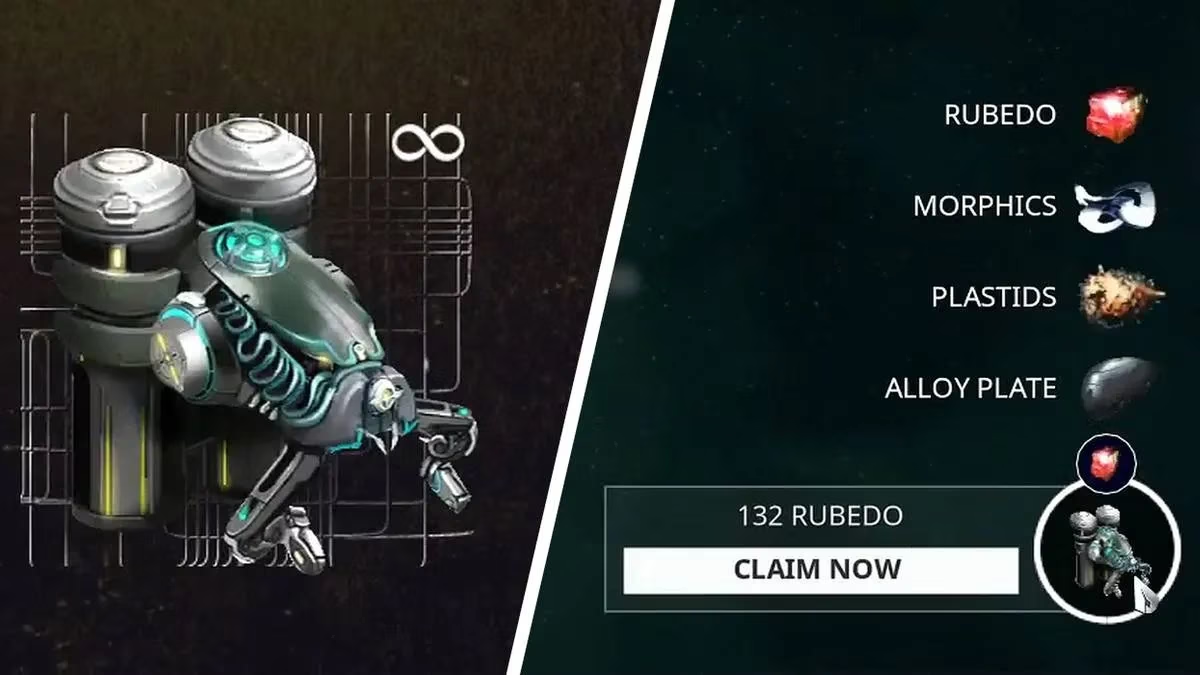
An Extractor is a deployable drone that autonomously harvests materials from a planet over real-world hours. Normally, if I’m low on a specific resource—say I suddenly need 4,000 Nano Spores for a new Dojo decoration—I’d jump into my orbiter, select the right node, and spend 20 minutes scavenging. But with an Extractor, I just tap a few buttons, and four or eight hours later I come back to a bundle of resources waiting in my inbox. Of course, the yields are randomized, so you won’t be drowning in Orokin Cells overnight. Yet the effort required is exactly zero button presses after deployment. That’s a win in my book.
So, what are the options?
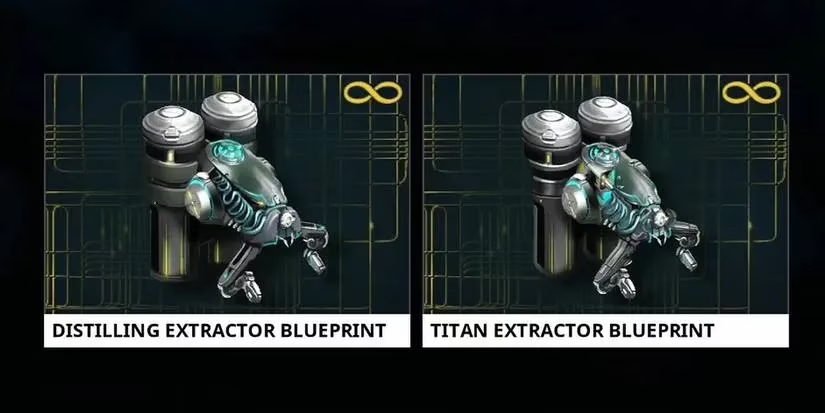
Warframe gives us two distinct Extractor types: the Titan Extractor and the Distilling Extractor. The Titan variant is the workhorse. It takes 4 real-world hours to complete a trip and returns with a standard mix of common materials appropriate for the planet. In contrast, the Distilling Extractor demands 8 hours, double the time, but the payoff is a higher chance at uncommon and rare resources. I personally keep a rotation of Distilling Extractors on planets like Deimos or Eris when I’m hunting Mutagen Samples or Neurodes. The extra wait is worth it when a shipment pops up with three Neurodes instead of ten thousand Alloy Plates.
Now you might wonder: “How do I even get these things?”
Both blueprints are available directly from the in-game Market for 50,000 Credits each. The catch is you also need to craft the actual drone at your Foundry. Here’s a quick breakdown I keep bookmarked:
| Extractor Type | Blueprint Cost | Crafting Cost (Foundry) |
|---|---|---|
| Titan Extractor | 50,000 Credits | 10,000 Credits, 500 Polymer Bundle, 300 Ferrite |
| Distilling Extractor | 50,000 Credits | 10,000 Credits, 500 Alloy Plate, 300 Nano Spores |
The blueprints are reusable, so you can mass-produce as many drones as you want—provided you’ve stockpiled the materials. I often queue up a batch of three Titan Extractors while I sleep, then deploy them in the morning. It’s a rhythm that requires some planning, but once you’re set, the resources start flowing like a river.
Limits, limits, limits.
Before you go printing fifty Extractors, remember: you can only deploy a maximum of three drones simultaneously, and your Mastery Rank dictates how many you can actually send out. For instance, a Mastery Rank 0-4 Tenno can only deploy one, while rank 15+ unlocks the full trio of dispatch slots. This restriction forces you to prioritize which planets need attention. Do you need Fieldron Samples from Jupiter? Or maybe Polymer Bundle from Venus? I always ask myself, “Which resource am I most likely to run out of in the middle of a late-night build session?” That’s the planet that gets an Extractor.
Another critical detail that new players often overlook is Extractor Health. Every drone returns with a bit of wear—each deployment chips away at its durability. Once the health reaches zero, the unit is destroyed. There’s no repair system; you simply craft a new one. The Foundry assembly time is a flat 6 real-world hours per Extractor, so don’t wait until your last drone keels over to start building replacements. I learned that lesson the hard way back when I ran out of Polymer Bundles mid-Nekros Prime build. Now, I maintain a personal rule: always have at least one full replacement drone ready for each type.
What about the meta in 2026?
While Warframe has evolved with countless updates, the Extractor framework remains largely unchanged because it simply works. The recent quality-of-life improvements even let you view extractor health directly from the mobile app, so you can manage your empire on the go. I’ve integrated Extractors into my daily login ritual: claim resources, rotate damaged drones, craft fresh ones, then dispatch a new set before I log out. It’s a loop that rewards consistency.
Here’s an example from my own playbook: every weekend I run a Distilling Extractor on Eris for Neurodes, a Titan Extractor on Saturn for Orokin Cells, and another Distilling on Deimos for Mutagen Samples. That nets me roughly 12–16 extra rare resources per week without stepping into a single mission. Pair this with occasional dedicated farming, and you’ll never be short on the materials that gatekeep your progression.
One final pro tip: don’t underestimate the value of common resources. A Titan Extractor on Earth might give you Ferrite and Rubedo, which sound boring—until you need 15,000 Rubedo for a new Archwing part. By passively stockpiling these, you sidestep the “Oh crap, I have to go to Earth” moments entirely.
Just be mindful that Extractors work on real-world time, not mission time. If you deploy a drone before a vacation, it’ll be ready when you return, but the clock keeps ticking even if the game is closed. Use this to your advantage. Start your Extractor, shut down your PC or console, and come back to a ready-made resource bundle. It’s the closest thing Warframe has to passive income.
In the end, Extractors won’t replace dedicated farming for massive hauls, but they fill the gaps beautifully. They’re the unsung heroes of my arsenal, the silent workers that keep my Foundry humming. Have you been ignoring them? If so, you’re leaving free resources on the table—literally on the planetary surface. Give them a try, stock up on blueprints, and watch your resource anxiety melt away. After all, a true Tenno knows that preparation is half the battle.
Comments